Agentic cheminformatics needs a replay ledger before a speed claim
Google DeepMind’s Antigravity walkthrough links an agent to chemistry databases and deterministic tools in a workflow reported at about an hour. The decision-grade evidence is a replayable chain of inputs, transforms and handoffs—not the demo clock.
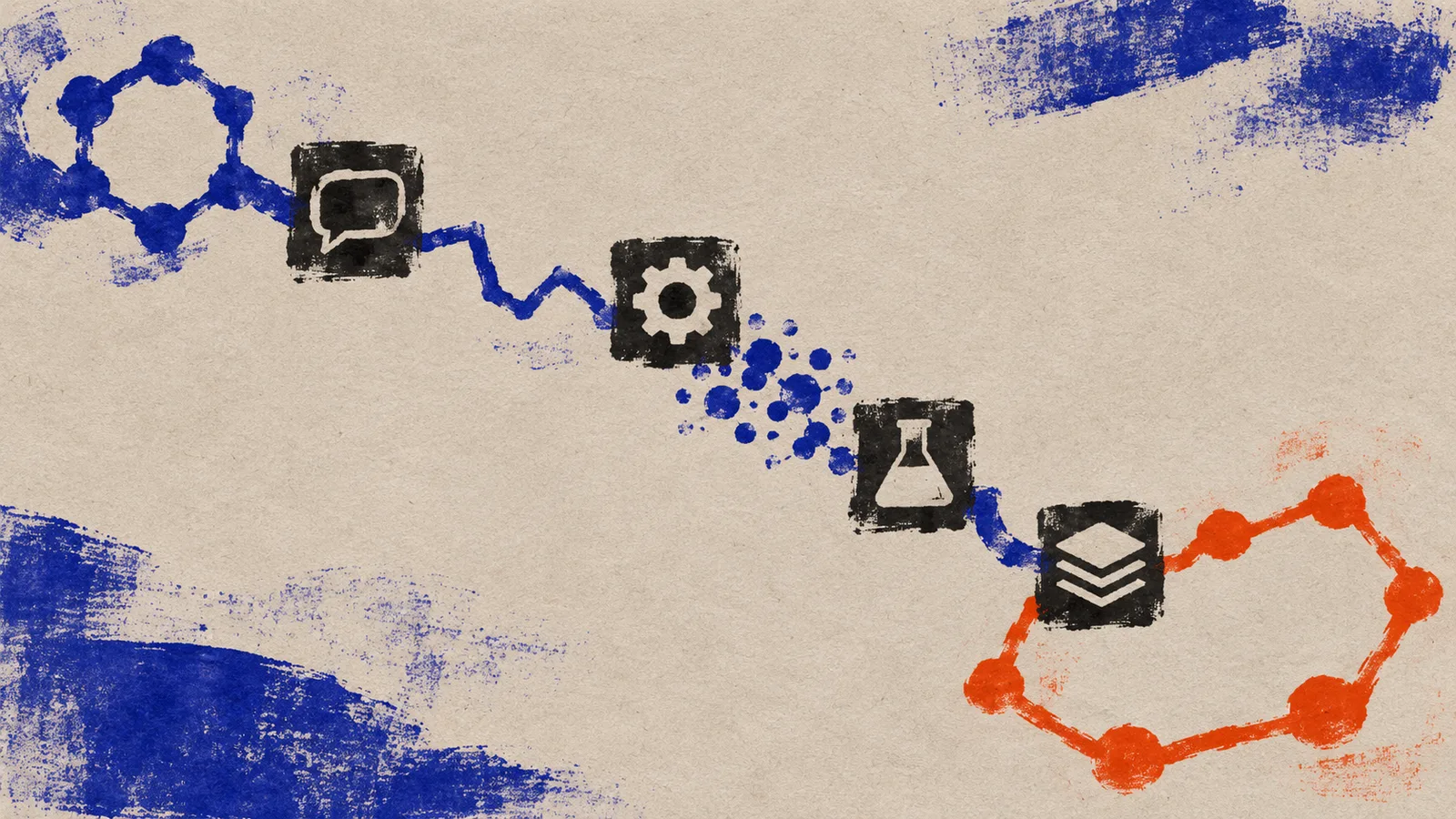
What happened
Google DeepMind published a walkthrough of Cheminformatics Skills for Antigravity, showing an agent coordinating compound search and analysis tools.
Why it matters
Scientific teams can gain from reduced data wrangling only if every representation change and deterministic operation remains inspectable and reproducible by a qualified human.
The useful claim is a division of labour
Google DeepMind’s Antigravity walkthrough shows a model coordinating compound search, matched molecular pair analysis and candidate generation with established chemistry resources and tools. Google says the demonstrated workflow, using real-world lung-cancer treatments as its starting point, produced proposals and synthetic routes in about an hour.
This is a developer-presented walkthrough. It does not by itself establish a productivity effect across scientists, independent reproduction, experimental validity, synthesizability, safety or a new medicine. The strongest design signal is narrower: language-model orchestration can be separated from deterministic domain operations that are inspectable on their own.
Record every boundary crossing
Create a replay ledger for a bounded retrospective task. Preserve the exact source record and access time; the extracted structure or identifier; every normalisation, salt removal, tautomer choice or exclusion; database and tool versions; parameters and random seeds; intermediate files; final outputs; and the human decision at each handoff.
Then ask a second chemist to reproduce the result without the agent’s prose. Compare not only elapsed time but also input correctness, failed or changed representations, unexplained exclusions, tool errors, reproducibility and review effort. A deterministic calculation constrains one class of error, but it cannot prove that the intended compound was extracted or that a proposal is experimentally meaningful.
IDHUS Institute independently analyses the walkthrough and makes the same boundary explicit: it is not a reproduced productivity trial or validated discovery. That source is commentary rather than peer-reviewed experimental evidence, so it bounds the claim rather than confirming performance.
This extends the workflow complementarity denominator: tool access becomes useful only when representation checks, domain review and reproducibility are present around it.
Decision rule
Run a retrospective replay before any prospective scientific use. Advance only when another qualified reviewer can reproduce the result from the ledger, explain every representation change and identify where model judgement ends and deterministic computation begins.