When AI weakens hiring signals, redesign the work sample before buying a detector
A WGU survey says 60% of U.S. hiring professionals find real skills harder to evaluate in the AI era. The actionable response is a transparent evidence chain, not an unvalidated authenticity score.
What happened
WGU’s second Workforce Decoded survey covered 3,128 U.S. hiring professionals between 24 June and 7 July 2026. It reports that 60% said AI made candidates’ real skills harder to evaluate, while 32% were still figuring out how to assess AI skills effectively, up from 16% in the comparable 2025 question.
Why it matters
The survey captures employer perceptions, not measured candidate deception or detector accuracy. Hiring teams still need reliable signals, but escalating to opaque detection can add false accusations and access barriers without showing what a person can do.
Western Governors University reported results from its second Workforce Decoded survey on 30 September. Centiment surveyed 3,128 U.S. respondents directly involved in hiring between 24 June and 7 July 2026. Sixty percent said AI had made candidates' real skills harder to evaluate. Nearly one in five cited difficulty confirming whether they were interviewing a person rather than AI as a top challenge. Thirty-two percent said they were still figuring out how to evaluate AI skills effectively, compared with 16% on a comparable 2025 question.
The same release reports an association with entry-level hiring: 54% of employers who said evaluation had become harder also reported reduced entry-level hiring, compared with 20% among those who did not report greater evaluation difficulty. That is not evidence that AI-caused uncertainty produced the hiring reduction. Both responses come from the same employer survey and may reflect industry, economy, hiring volume or respondent attitude.
Replace authenticity with provenance
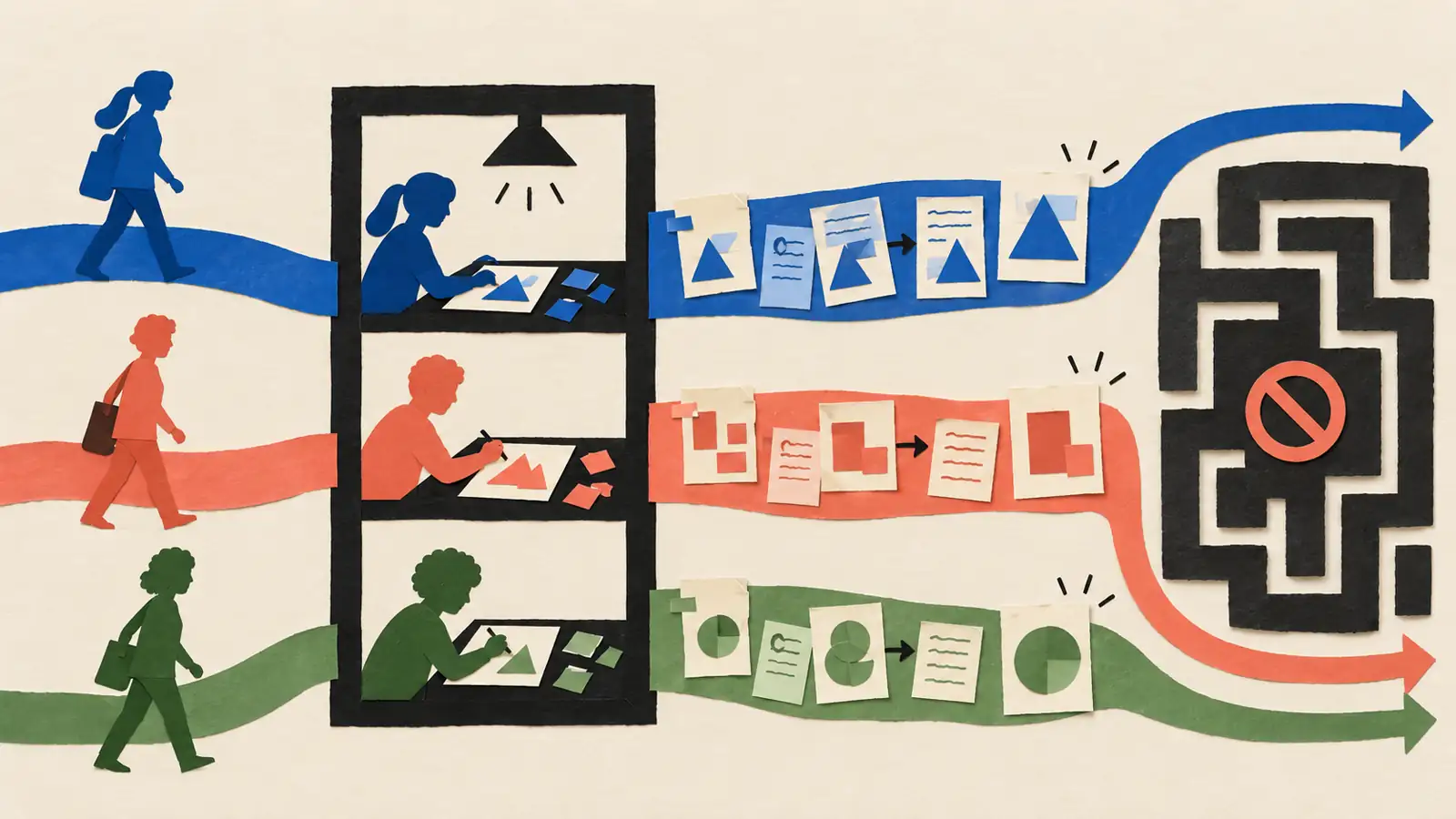
Do not ask a detector to decide whether a candidate is genuine. Ask the assessment to show how work was produced. Use a short, job-relevant task with declared AI rules. Capture an initial plan, sources or inputs, intermediate decisions, revisions after feedback and a live explanation of trade-offs. Score the quality of the result, reasoning, error correction and responsible tool use against a published rubric.
Offer equivalent accessible routes. A timed live task may disadvantage candidates with disabilities, caregiving responsibilities, language differences or unreliable connectivity. Provide a take-home option with an oral walkthrough, or an observed task with preparation time. Keep the construct being tested stable across routes.
Validate the assessment
Pilot the work sample with current employees and new candidates. Compare trained raters, measure disagreement and review adverse patterns. Track which score elements predict later performance without assuming correlation is causation. Audit whether reviewers reward polished output while missing weak judgment or penalise legitimate assistive technology.
The counterargument is that structured work samples cost more than automated screening. They do. Focus them on roles where a false positive or false negative is material, sample lower-risk roles and reuse stable task families. The cost of a detector is not only its licence; it includes appeals, candidate loss, bias investigation and wrong decisions.
The Skills Intelligence Role Dictionary can connect each task to an explicit role outcome and boundary. It should not be used to infer skill from writing style or an AI-detection score.
The immediate decision is to replace one opaque screening signal with a two-stage work sample: transparent process evidence followed by a structured explanation. Measure inter-rater reliability and candidate burden before scaling. The WGU survey is a reason to inspect the signal system, not proof that applicants are less capable or less honest.