AI wet labs need validation and operations roles before autonomy claims
Anthropic confirmed a Bay Area wet lab and early work on automating experiments. The immediate workforce demand is for reproducibility, lab operations and human validation.
What happened
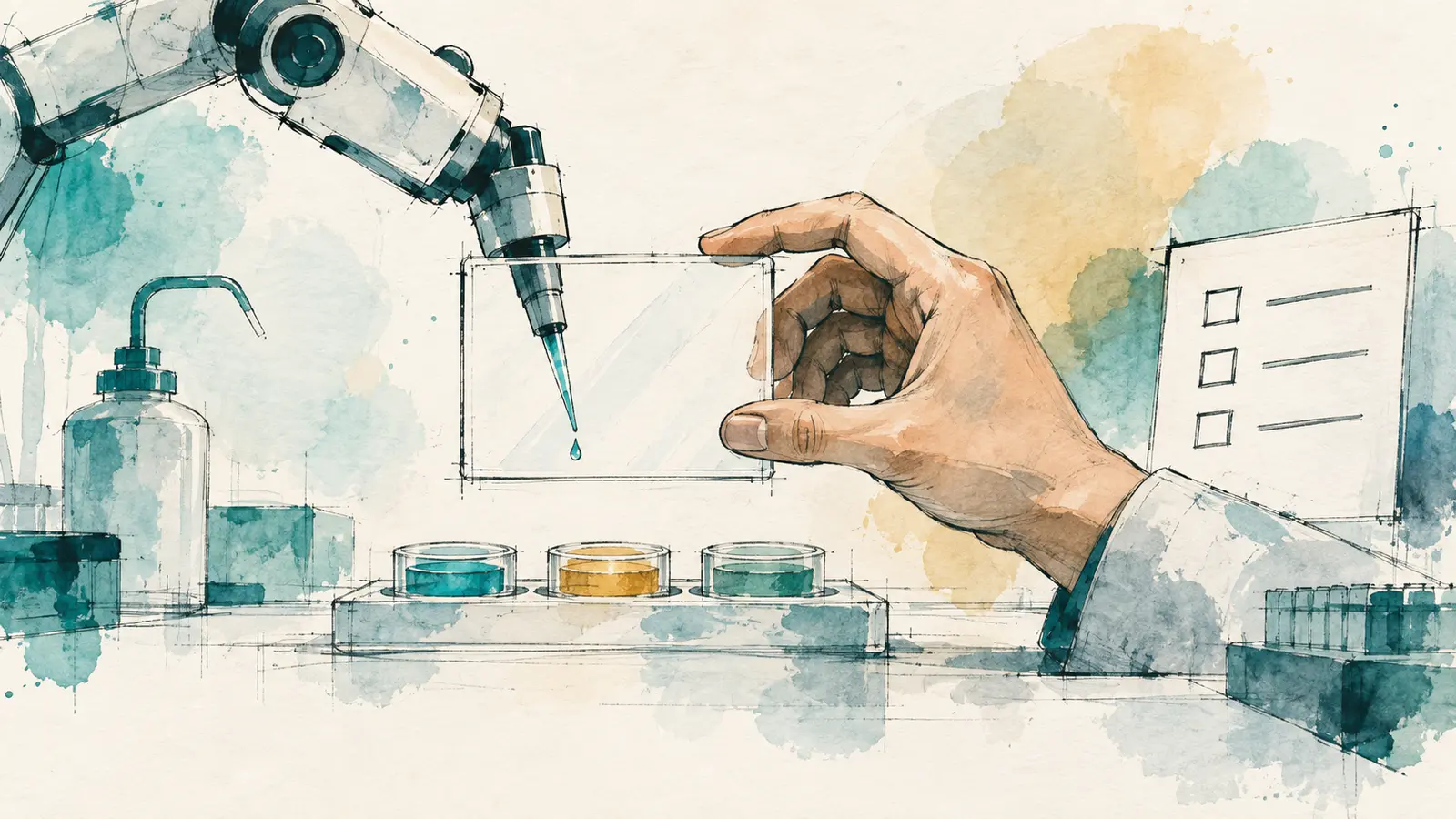
Reuters reported that Anthropic confirmed a physical biology laboratory, external lab partners and hiring for procurement and biochemical characterisation.
Why it matters
Moving from computation to physical experiments adds chain-of-custody, calibration, biosafety and reproducibility work that model capability alone cannot supply.
Reuters reported that Anthropic has established a Bay Area wet lab and is combining internal work with external partners. Its head of life sciences described laboratory automation as being in the “very early innings”; a spokesperson said human oversight remains essential. The report also pointed to hiring for procurement and laboratory operations and for protein and nucleic-acid characterisation.
This is not evidence that autonomous AI can discover and deliver a medicine. Anthropic said it is not running clinical trials, the diseases and progress remain unclear, and most drug candidates fail safety or efficacy testing. The more immediate change is organisational: software claims now meet physical samples, instruments and irreversible actions.
Staff the verification chain
A lab using agents needs named owners for experimental design, instrument qualification, sample identity, data provenance, anomaly review and release of results. Procurement becomes a scientific control when reagents, consumables or device firmware can change an outcome. Lab operations staff need authority to pause a run when calibration, containment or chain-of-custody evidence is missing.
Anthropic's Claude Science page emphasises reproducible artefacts, code history and background checks for citations and figures. Those capabilities cover part of the computational record. They do not replace wet-lab controls, independent replication or accountable scientific judgement.
Design a bounded pilot
Start with a reversible, low-hazard workflow whose expected output is known. Separate planning, execution and result acceptance. Require a human to approve every new instrument command or protocol change until error modes are understood. Preserve raw readings, model instructions, tool calls, reagent lots and deviations in one audit trail.
Measure repeatability, contamination events, manual interventions, cycle time and invalidated runs—not the number of experiments started. A claimed acceleration is decision-grade only when the same quality threshold is maintained. The Skills Intelligence governance guidance should treat validation and operations as core AI-era roles, not support work to be added after autonomy.