An agent builder should not own the held-out acceptance gate
AppSci-Bench reports that frontier models can saturate self-designed evaluations while missing held-out tasks. Separate improvement evidence from release evidence.
What happened
A new benchmark tests whether models can elicit requirements, build agents and improve them across seven business domains.
Why it matters
A builder that defines and optimizes its own test can look finished while missing requirements that matter in deployment.
Improvement evidence is not release evidence
AppSci-Bench asks models to do more than operate an agent. Across seven domains, they must elicit stakeholder requirements, inspect business infrastructure, build or modify an agent, run experiments and create internal benchmarks. Each domain also has a customized held-out evaluation suite.
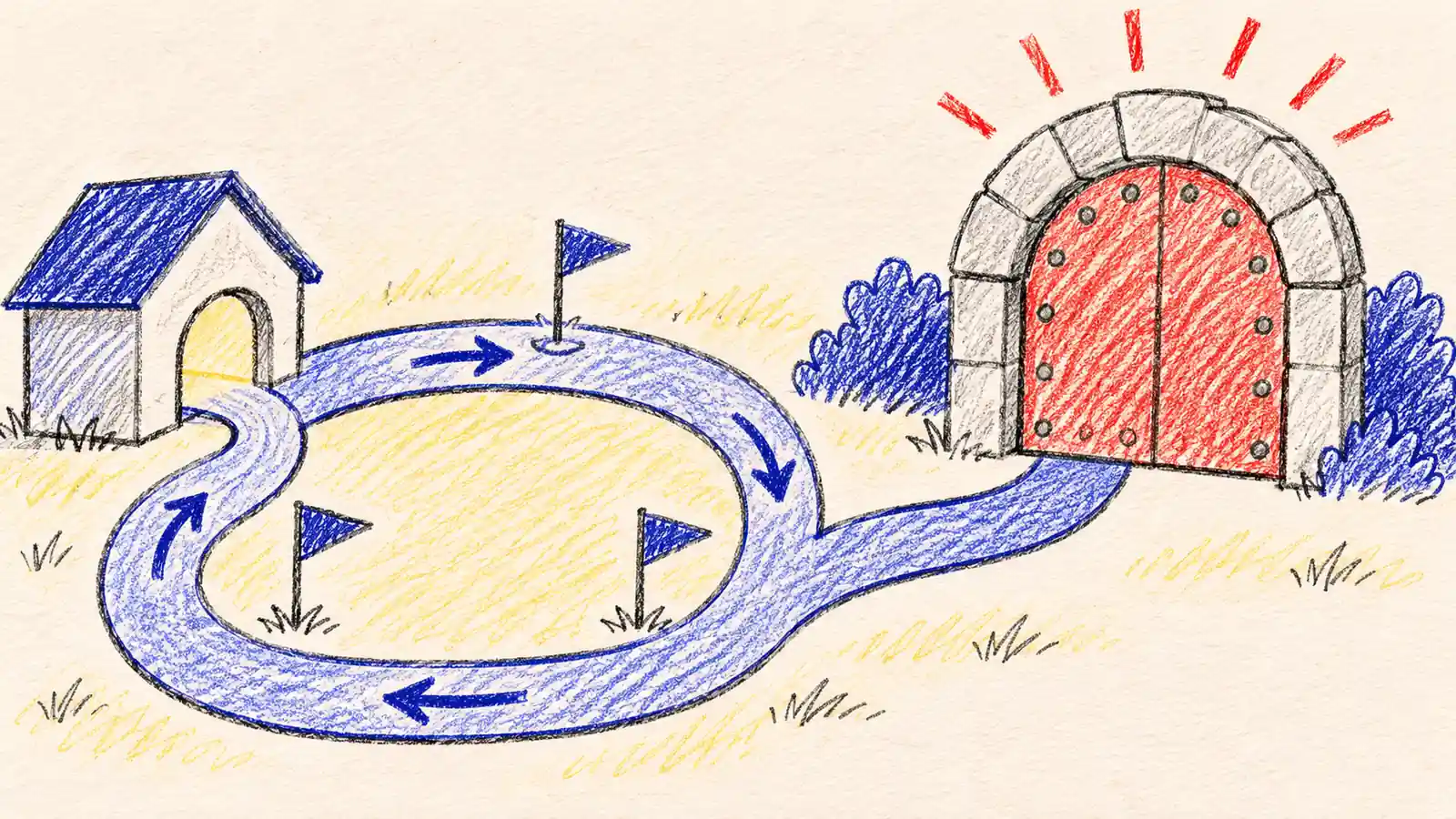
The authors report that the best tested model reached a 59.1% mean-minimum score across three build attempts and elicited 65% of requirements. A more important control finding is that models often saturated the evaluation they designed while still failing held-out tasks. AI Paper Digest independently summarized the same separation between self-evaluation and external performance.
This is an unreviewed preprint, not a production failure estimate. Seven constructed domains, a particular harness and three attempts per model cannot predict every organization. Yet the failure mode is general: the same system can narrow the test to what it already learned to improve.
Separate the acceptance authority
Before optimization, freeze a human-owned requirement ledger with source, priority, observable acceptance condition and unresolved ambiguity. Keep a held-out set outside the builder's editable workspace. Require repeated runs, failure replay and traceability from every material requirement to at least one acceptance case. Changes to the held-out set should need an owner who is not rewarded for the builder's score.
This extends decision-scenario evaluation: the scenario remains useful only if the builder cannot redefine success after seeing failures.
Decision rule
Do not release an agent because its own benchmark is green. Release only when an independent acceptance owner can reproduce coverage and the held-out failures remain within a pre-agreed budget.