Barnsley’s four AI training pilots need one transfer ledger
More than £800,000 will fund four deliberately different local programmes. That variety is useful only if each provider records comparable baselines, workplace transfer and follow-up outcomes before any national rollout.
What happened
The UK government awarded more than £800,000 to four Barnsley AI upskilling projects serving care staff, workers in six firms, 100 residents and 20 small businesses.
Why it matters
Four delivery models can reveal which support works for whom, but attendance and confidence alone would not show whether skills transfer into safer or better workplace decisions.
Four pilots, four different tests
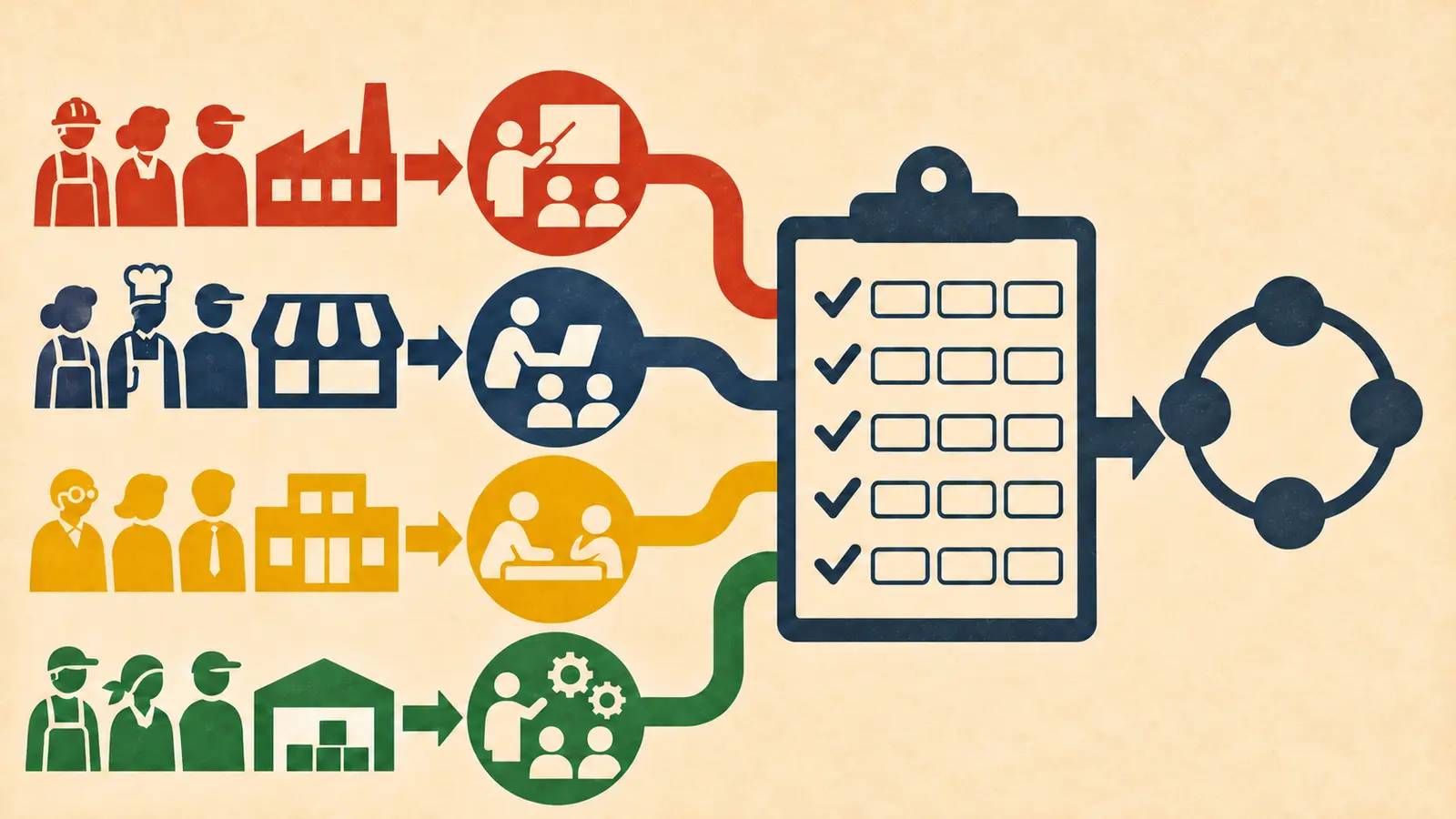
The UK government’s 3 November award announcement commits more than £800,000 to four Barnsley projects. Barnsley College will take mobile training to hospital and social-care staff and the wider community. Atheni receives £231,000 to work with 140 people, mostly aged 40 or over, across six manufacturing, engineering and construction firms. Fossu receives £195,188 for challenge-led programmes and buildathons with 100 residents. Optimise Cyber Solutions receives £200,000 to support 20 small businesses. The fourth award, £184,403, goes to Barnsley College.
Those are not interchangeable courses. One tests mobile access, one embeds company documents and trade context, one uses community buildathons, and one combines adoption support with responsible-use training. The variation creates a useful portfolio. It also makes a simple total of learners or completions a poor comparison.
Transfer is the missing common denominator
The announcement describes intended benefits such as confidence, employability, time saving and practical adoption. It does not publish a shared measurement protocol for the four providers. That is not evidence of a weak programme; awards have just been made. It is a reason to design the comparison before delivery starts.
A separate cluster-randomized workplace study shows what a more disciplined design can reveal. Across six county-level power-supply companies in China, 2,574 employees were analysed after matched training batches were randomly allocated to an adaptive or uniform programme. The adaptive bundle produced small advantages in self-efficacy (d about 0.26), transfer intention (d about 0.25) and knowledge (d about 0.29 immediately after training; about 0.26 at six weeks).
That study is not a forecast for Barnsley. It tested one employer system, one national context and a bundle that changed both delivery medium and adaptive routing. It measured transfer intention, not observed workplace performance. Its value here is methodological: baseline balance, an active comparison, follow-up and explicit effect sizes make a training claim more interpretable.
Build one ledger before delivery diverges
Each provider should record the same minimum fields: participant cohort and prior AI use; one representative work task; the pre-training error, time or escalation rate; tool and data boundaries; completion and non-completion; an observed task sample after training; a six-week follow-up; and any unsafe use, non-use or work shifted to colleagues. Measures can differ by task, but definitions and timing should be fixed centrally.
The ledger also needs a denominator for every reported gain. A faster task among people who completed training is not the same result as improvement across everyone enrolled. Providers should therefore retain the number invited, enrolled, completed, observed at work and reached at follow-up. They should separate a capability gain from a tool-access effect, and record whether managers changed the task, staffing or approval route during the pilot. Without those fields, a promising case can be real while the programme-level comparison remains misleading.
The comparison does not require one universal productivity metric. It requires a common sequence: baseline, supported practice, bounded work sample and follow-up. Barnsley can then compare transfer rates and support requirements while leaving task-specific quality criteria with the relevant sector. That preserves the difference between safe care escalation, an engineering workflow and a small-business adoption decision instead of flattening them into course satisfaction.
Comparison should remain cohort-aware. A care worker’s safe escalation decision is not equivalent to a construction tender or a small company’s adoption plan. The shared question is whether a named capability moved from the learning setting into bounded work, with no unacceptable harm or hidden verification load.
This extends the local-pilot rule for AI learning evidence: a positive average elsewhere cannot replace a local baseline and follow-up.
Decision rule
Treat the four awards as a comparative learning portfolio, not four proofs of impact. Do not call a model a national blueprint until the common ledger shows who completed, what changed in real work, what did not transfer and what support the change required.