ChatGPT work-use data is a task-mix lens, not a workforce census
OpenAI’s activity-level analysis shows broader work use across countries, but its individual-plan sample and omitted categories make it unsuitable as a direct headcount or enterprise-adoption measure.
What happened
OpenAI published Signals v3.0 on 26 October 2026, classifying work-related ChatGPT conversations into 165 O*NET-derived activities across nearly 100 countries and reporting a less concentrated activity mix over time.
Why it matters
The dataset can help leaders identify candidate tasks for local investigation, but it does not measure enterprise deployment, Codex use, productivity, job loss or the full task mix of an occupation.
What the release measures
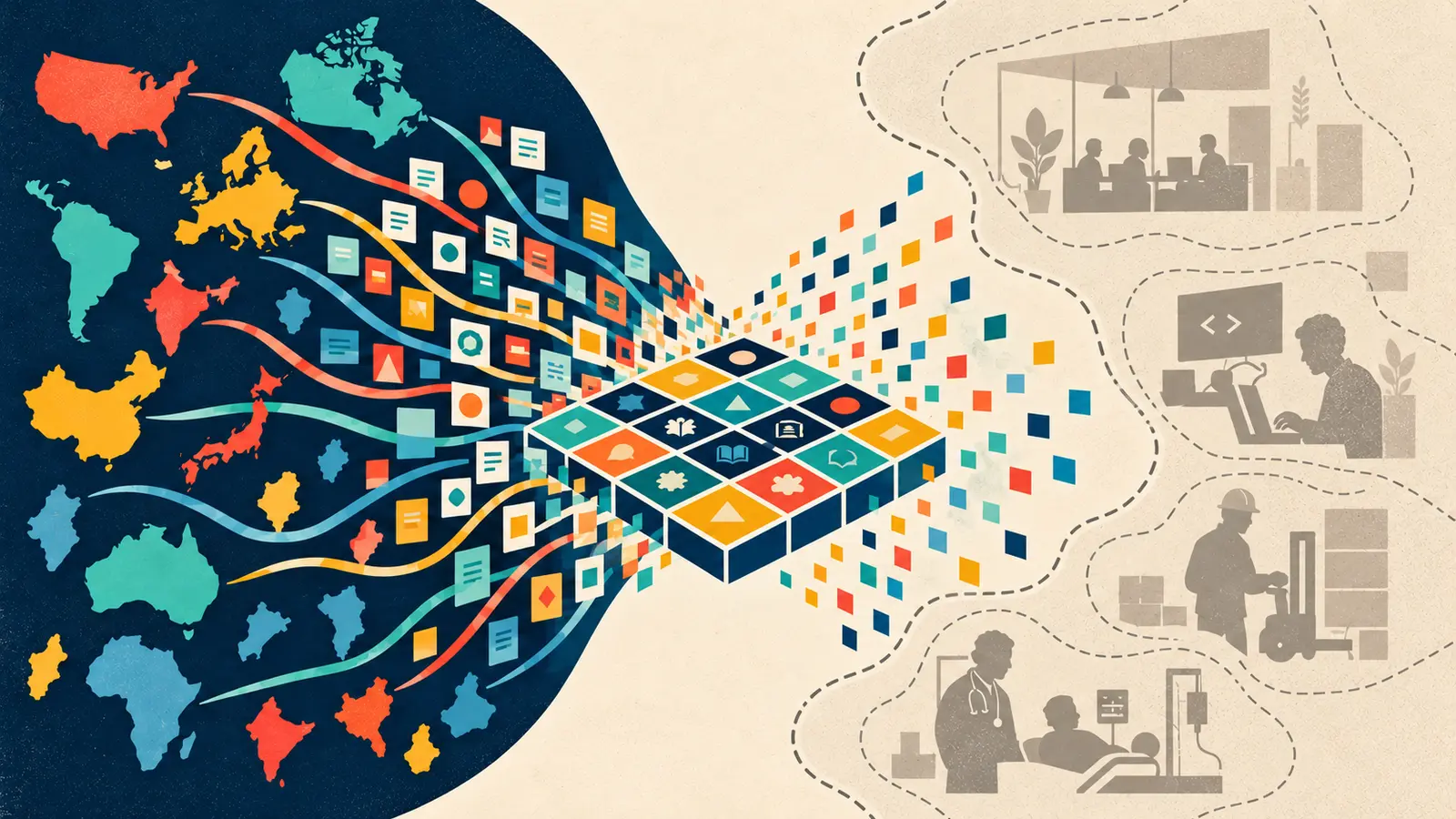
OpenAI Signals v3.0 classifies work-related messages from individual ChatGPT plans into 165 Intermediate Work Activities adapted from O*NET. The release covers nearly 100 countries and reports aggregated patterns after automated classification, deidentification, minimum-volume thresholds and statistical noise. Its unit is a classified conversation activity, not a worker, job or completed business process.
The headline diversification result is descriptive. For 74 countries observed in every quarter, the average within-country share represented by the ten most common activities fell from 56.0% in the first quarter of 2025 to 51.1% in the third quarter of 2026. That says the observed mix broadened. It does not show that every occupation adopted ChatGPT, that the same people expanded their task range, or that output improved.
The missing denominator
The sample excludes enterprise messages and Codex. Those exclusions matter because enterprise controls, workflow integration and coding agents can produce a different task mix from individual-plan conversations. The release also compares activity categories with an employment-weighted O*NET task distribution in which a large residual “Other” category remains. A leader cannot reconstruct a complete job architecture by subtracting the named shares.
Classification error and reporting noise add another boundary. Categories describe what a message appears to request; they do not confirm that a task was completed, accepted or used in a real decision. Country-level reporting can reveal variation without explaining whether access, language, occupation, policy or product mix produced it.
Turn a signal into local evidence
Use the public taxonomy as a sampling frame. Select a small number of activities relevant to one workflow, then observe how often they occur, who can use them, what inputs are permitted, where human review enters and which outcome changes. Record the product and plan type so individual-chat behaviour is not silently treated as enterprise deployment.
Pair message evidence with work evidence. A useful local note links the request to a process step, accountable role, quality criterion, exception rate and downstream rework. It also records tasks that never appear in chat because they are physical, interpersonal, confidential or performed in another tool. That negative space prevents a convenient digital trace from becoming the whole job.
Do not rank employees or occupations from conversation shares. The dataset is aggregated and designed for population analysis, while an employer decision affects identifiable people. Any local study needs purpose limitation, access controls, worker consultation and suppression rules before individual-level records are considered.
Publish sampling misses as deliberately as successes. If a locally important task has no matching category, or if workers use a different product, record the mismatch instead of forcing it into the nearest label. A stable crosswalk should keep the original activity code, the local task name, the mapping rationale and the date of review so later taxonomy changes remain auditable.
Decision rule
Do not change headcount, role design or a learning budget because a category is growing in Signals. Require a local task sample with a named denominator, product boundary, observed outcome, exceptions and unmeasured work. If those fields are missing, label the finding “conversation activity” rather than “workforce adoption”. This extends the earlier distinction between enterprise usage and transformation into a reproducible task-level check.