A skills-synergy index is a learning signal, not a labour-demand ranking
Coursera’s 2026 report pairs AI and human-skill learning across 98 countries. The index can guide curriculum questions, but platform activity cannot prove employer demand or workplace capability.
What happened
Coursera released its 2026 Global Skills Report on 28 September, drawing on a subset of learning data from more than 300 million Coursera and Udemy learners and introducing an AI–Human Skills Synergy Index for 98 countries.
Why it matters
The data reveal what platform learners choose and which skills co-occur; they do not directly measure population attainment, employer demand, job performance or causal returns from training.
Coursera’s 2026 Global Skills Report introduces an AI–Human Skills Synergy Index across 98 countries. The company says the report draws on a subset of activity from more than 300 million Coursera and Udemy learners. It reports more than 45 generative-AI enrolments per minute, up from 25 in 2025, and a 107% year-over-year increase in critical-thinking enrolments.
Those figures are useful because they show revealed learning behaviour inside two large platforms. They are not a census of national skills. The learner population is self-selected, access and catalogue composition vary by country, and enrolment records participation rather than mastery or workplace transfer. A country rank therefore cannot support a claim that one workforce is more capable than another.
Read the index as a pairing hypothesis
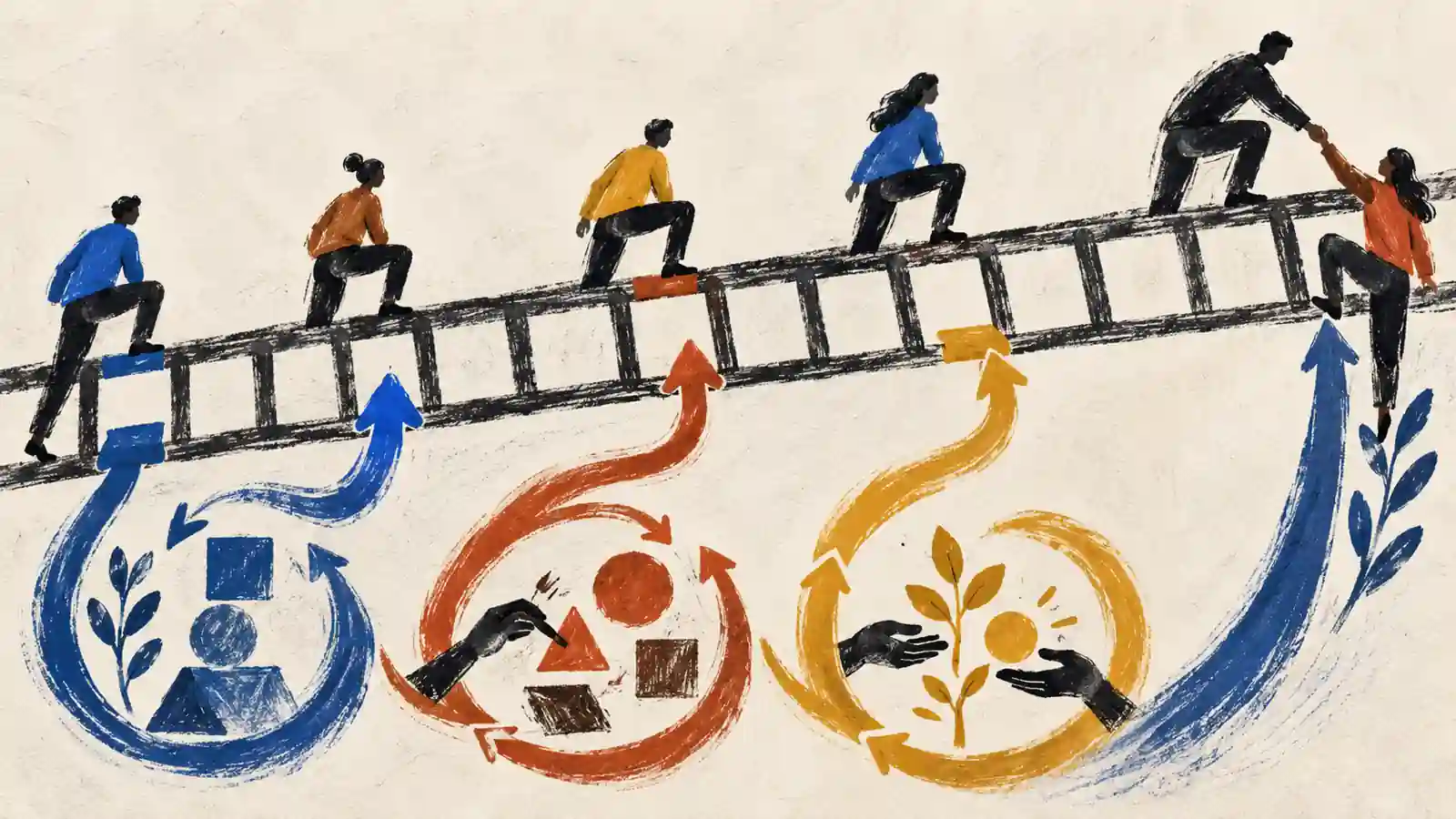
The strongest operational signal is not the league table. It is the repeated pairing of applied AI learning with judgment, innovation, stakeholder alignment, ethics, governance and complex problem-solving. That suggests a curriculum design question: which human capability must be practised inside the same work sample as the AI technique?
For example, an analyst learning model-assisted research can also practise source checking and uncertainty communication. A manager learning agent orchestration can practise escalation design and decision ownership. The paired exercise is testable: assess the technical output, the review trail and the decision explanation separately.
The OECD’s Skills in the AI Age provides an important boundary. It estimates that advanced AI skills remain concentrated in roughly 1% of the workforce while broader foundational, digital and complementary skills matter across AI-exposed work. Exposure to AI is not equivalent to automation, and a skills requirement is not evidence that a course caused an employment outcome.
Build a local transfer test
Choose one role and one high-frequency task. Map one AI technique and one human control skill to the task, then create a before-and-after work sample. Score accuracy, exception handling, evidence quality and explanation. Record who participated, what support they received and whether performance persists after four weeks.
The Skills Intelligence Role Dictionary can anchor task and accountability fields without turning the platform index into a role forecast.
The counterargument is that large-scale platform behaviour may anticipate labour demand faster than occupational surveys. It may. But provider incentives, catalogue changes and marketing can also move enrolments. Triangulate the learning signal with job postings, manager interviews and observed task data before changing a portfolio.
The immediate decision is to replace a generic “AI literacy” module with one paired task experiment, while treating the global index as a discovery tool rather than a ranking of workforce readiness.