A limited frontier-model release needs a failure-path retest, not a benchmark victory lap
Google’s Gemini 4 Argon launch combines strong vendor benchmarks with restricted cyber-defender access. Buyers should use the staged boundary to test transfer, containment and rollback before wider adoption.
What happened
Google announced Gemini 4 Argon on 30 September and said it was rolling out first to trusted cyber defenders through the Fairwind programme while participating in a U.S. pre-release access process. Reuters reported that Google showed leading results on some benchmarks and trailing results on others, with no public-release date.
Why it matters
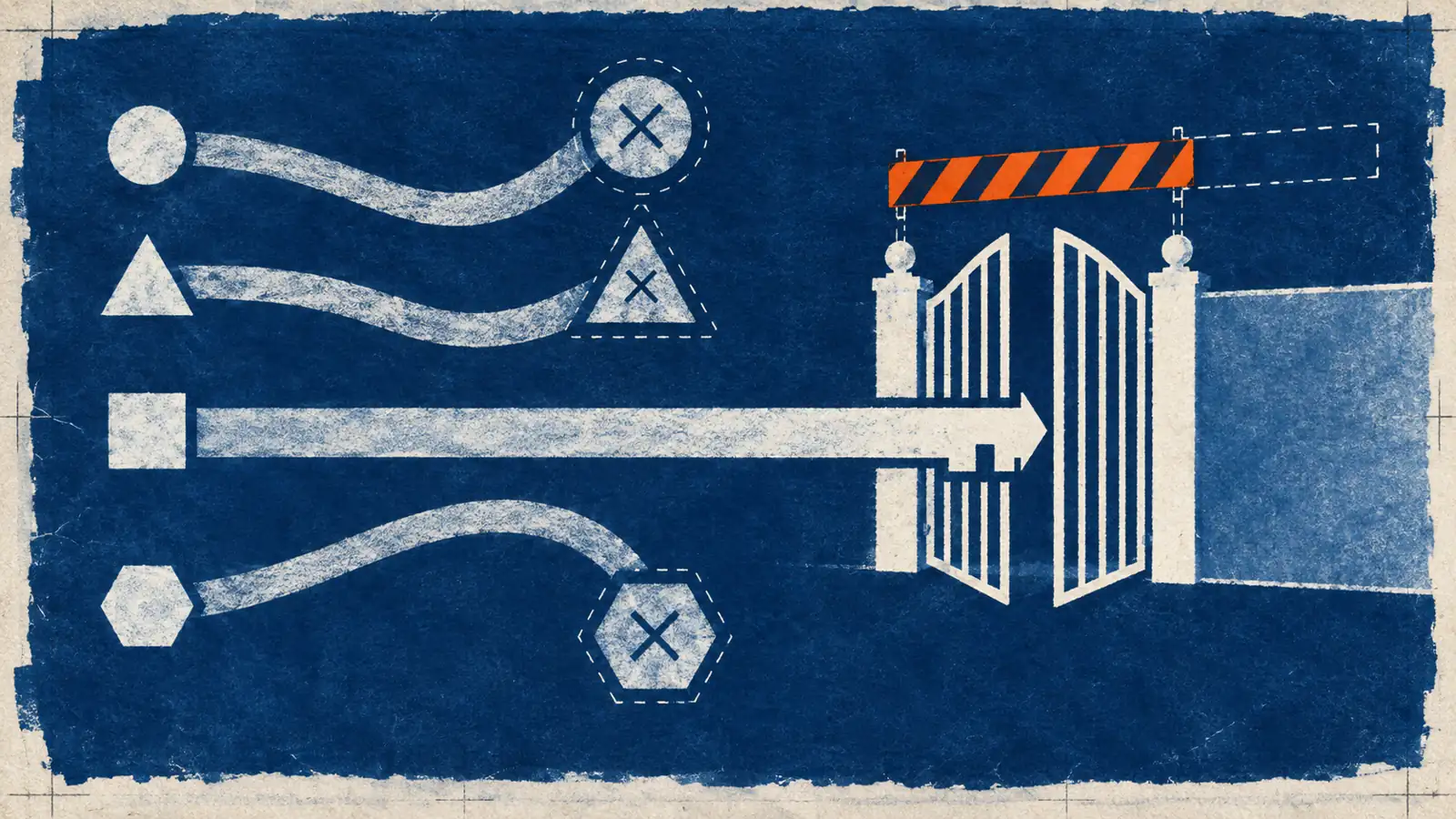
Restricted access is not merely a commercial queue. It is a chance to define which failure paths must be reproduced in the buyer’s tools, permissions and data before a capability claim becomes a deployment decision.
Google announced Gemini 4 Argon on 30 September and said the model would first reach a set of trusted cyber defenders through its Fairwind programme. The company described frontier performance across software engineering, enterprise knowledge work and cyber defence, a phased release, guardrail iteration and participation in a U.S. pre-release access process. Reuters reported that Argon led Astra and Opus on several company-reported benchmarks but remained behind on two of four coding measures Google included. Google gave no public-release date.
Those facts support neither a claim that Argon is the best model for a particular organisation nor a claim that restricted access proves safety. Vendor benchmarks answer bounded questions under chosen conditions. A trusted-partner programme can produce more useful evidence only if early users pre-register the tasks, boundaries and failure cases they will test.
Define the transfer test
Start from one consequential workflow, not a general model ranking. Specify the repository, tool permissions, secret boundaries, network destinations, time budget, human approval points and acceptable failure rate. Re-run a representative baseline model and Argon on the same frozen cases. Separate task completion from policy compliance; a model that finds more vulnerabilities but exceeds its authority has not passed.
Add cases that benchmarks tend to hide: ambiguous instructions, poisoned documentation, stale credentials, indirect prompt injection, partial outages and rollback after a tool call. Measure evidence quality as well as success. A reviewer should be able to identify which input caused an action, which policy allowed it and whether the model stopped when authority expired.
Make staged access reversible
The access cohort should have a written exit rule. Predefine the conditions that pause a use case, revoke a credential, disable an integration or widen access. Keep test identities and production identities separate. Do not let a partner label substitute for least privilege, monitoring and a human decision owner.
The counterargument is that restricted cyber access limits independent reproduction and may delay evidence for ordinary enterprise work. That is true. It should lower confidence outside the tested domain, not encourage extrapolation. Reuters also notes mixed benchmark performance, which is another reason to keep conclusions task-specific.
Keep an evaluation record that another team can rerun. Store the exact model identifier, date, harness version, prompts, tool schemas, environmental fixtures, scoring rubric, reviewer disagreements and every excluded case. A pass should identify the scope it covers and the uncertainty it leaves. Do not silently refresh prompts or test data after seeing a result; version the change and report both runs.
Expansion should proceed by authority tier, not user count. First widen the number of tasks that share the same permissions, then test a new tool, then a new data class. At each tier, require stable containment, acceptable task quality, reviewer agreement and a rehearsed rollback. This makes a phased release informative even when the vendor's public benchmark cannot be independently reproduced.
The Skills Intelligence Atlas can help name the engineering, evaluation, security and incident-response capabilities needed for the pilot. It cannot certify the model. Human security review remains necessary, and the model should stay outside a production authority path until the local evidence meets the predefined gate.
The immediate decision is to write a one-page transfer protocol before seeking access: frozen tasks, authority boundary, adversarial cases, baseline, pass threshold and rollback owner. A limited release is valuable when it narrows uncertainty, not when it merely imports a launch scorecard.