World-model demos need continuity tests before they become training environments
Google DeepMind’s Genie 4 preview adds native audio and more realistic interactive scenes, while its stated drift and consistency limits define the acceptance tests that matter.
What happened
Google DeepMind introduced Genie 4 on 27 October 2026 as a world-simulation model with improved visual realism, motion and native audio, available initially to trusted testers.
Why it matters
A compelling short session can still fail as a learning or evaluation environment if objects, space, physics or instructions drift across time and edits.
What was previewed
Google DeepMind introduced Genie 4 as an interactive world-simulation model with improved visual realism, movement and native audio. It is initially available to trusted testers. The Verge separately describes the preview and its more lifelike generated scenes.
The same release lists important continuing challenges: visual drift, object permanence across time and repeated edits, navigation, complex physical interactions, audio accuracy, legible text, spatial accuracy and long-term consistency. Those limits are not footnotes for training use; they define the test plan.
Test a sequence, not a frame
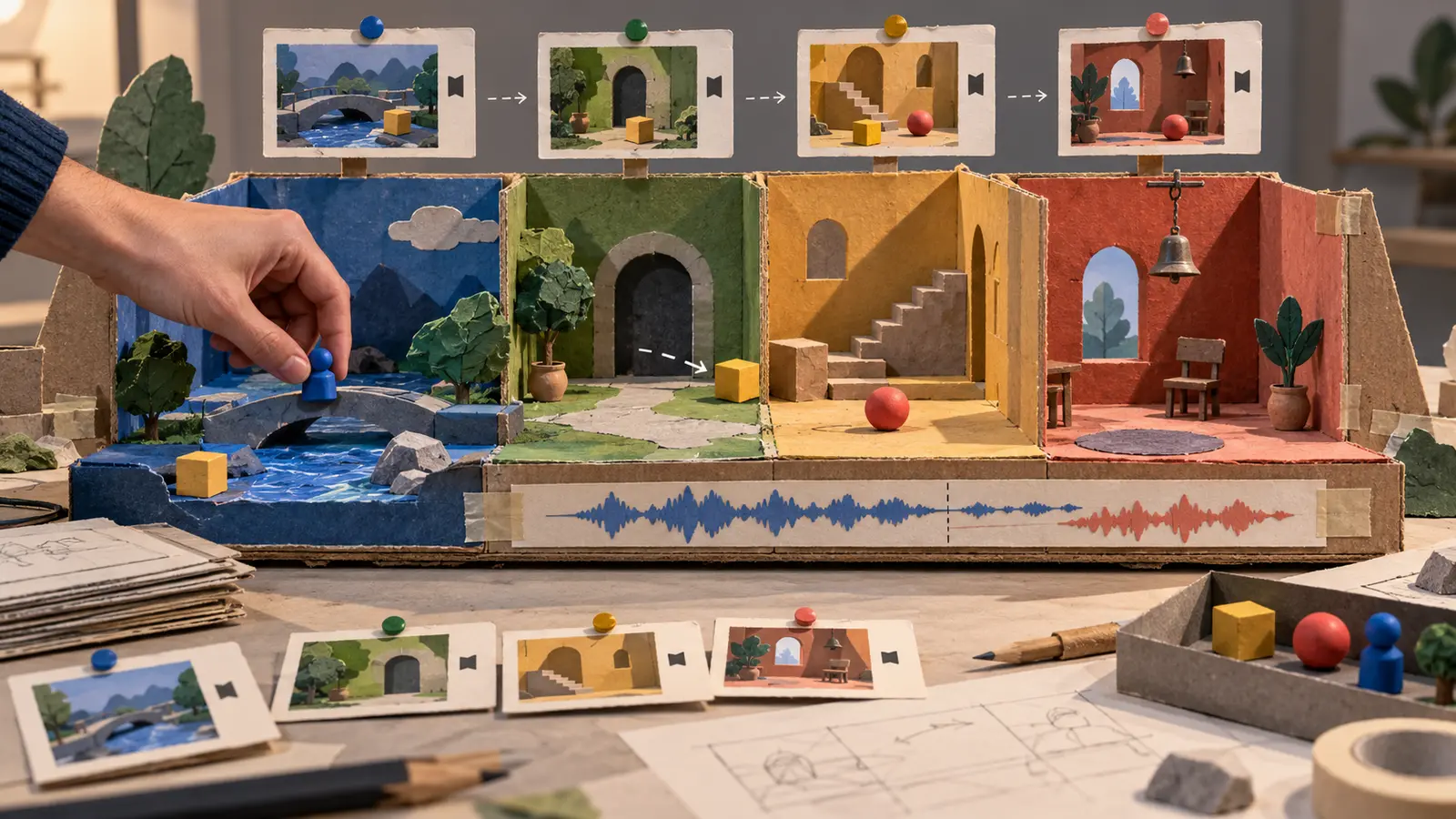
Create a scripted route through the environment. Place an object, leave the room, change one unrelated feature, return and check identity, position and state. Repeat after several edits. Test whether an instruction remains valid after navigation and whether a physical consequence is consistent when the route changes. For audio, check source location, timing and persistence rather than presence alone.
Record failures by step and severity. A cosmetic texture shift may be acceptable for brainstorming; a disappearing safety cue, changed tool state or inconsistent scoring object is not acceptable for assessment. Compare the generated scene with a fixed reference script, and preserve the session evidence so reviewers can reproduce the judgement.
Decision rule
Do not approve a generated world for consequential practice because a short demo is persuasive. Require a multi-step continuity suite covering object state, spatial relations, physics, audio, text and recovery after edits. Set failure thresholds by use case and keep a human fallback. This applies the earlier principle of auditable capability claims to interactive simulation.