Compile repeated agent work only after replay and repair
ReTrace converts an SOP and a few agent traces into a planner-free workflow. Its own results show why deterministic reuse needs coverage, failure repair and a fallback path.
What happened
Researchers updated the ReTrace paper on 11 November 2026, reporting production and benchmark tests of agent-to-workflow distillation.
Why it matters
Removing runtime planning can cut cost and latency, but it can also freeze incomplete branch logic into a fast repeatable failure.
Fast execution can preserve the wrong branch
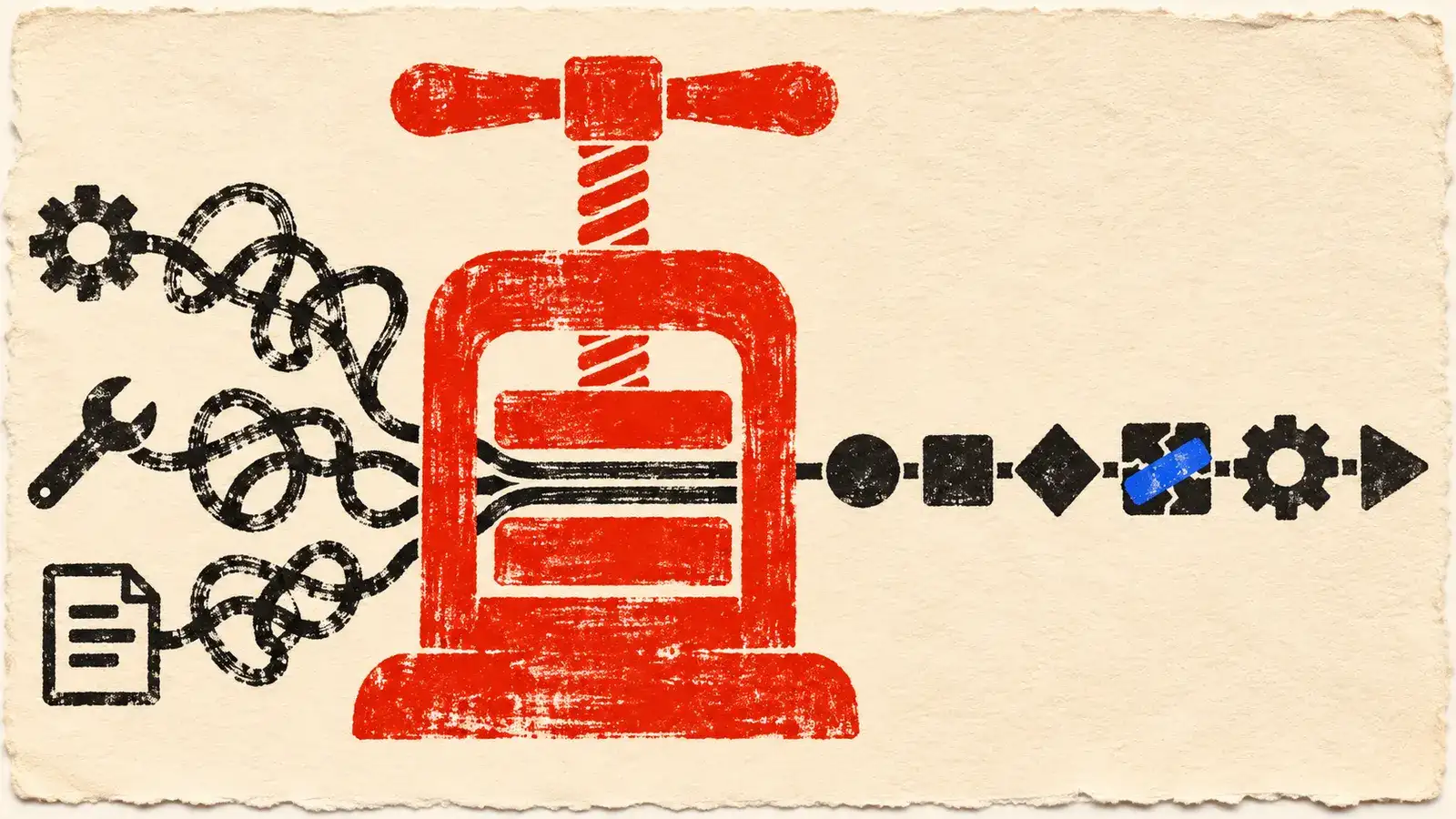
ReTrace takes a standard operating procedure and a small set of logged agent runs, extracts the conditions behind tool choices from the agent's reasoning, merges them into a compact rule document and compiles an executable workflow. Code then selects the next step without calling a language model planner on every transition.
Across 79 production procedures, the compiled workflows reached 93.8% completion, compared with 96.8% for the agent, at 24% lower cost per task. On tau2-Bench, they achieved 75.8% task success versus 80.6% for the agent and ran in 1.3 seconds instead of 170 seconds. Repair matters: three rounds using labelled training failures lifted one k=2 setting from 66.7% to 81.2%. On eight SOP-Bench procedures, unrepaired workflows trailed few-shot generation, while repair lifted them to 87.8% at 0.40 seconds per task, compared with 85.5% in 46.6 seconds for the agent.
These results are promising but bounded. Completion is not the same as correctness or safety, and the production procedures come from the authors' platform. An independent paper summary reproduces the reported comparisons but does not independently rerun them.
Create a compilation gate
Compile only a mature procedure with a stable objective, typed inputs, bounded tools, explicit approvals and a known exception set. Store the source SOP, trace IDs, extracted conditions, compiler version and unsupported branches. Replay the workflow on held-out normal cases, edge cases, permission failures and deliberately contradictory inputs.
Treat every discovered failure as a repair candidate, then rerun the complete suite. Measure completion, result correctness, protected-action violations, fallback rate, latency, cost and operator review time. Retain the planner or a human escalation path for states outside the compiled coverage.
This sharpens the model–harness pairing record: the compiled workflow is another harness version and must remain linked to the traces and policy that produced it.
Decision rule
Do not replace an agent planner because a workflow is faster on familiar cases. Compile only after held-out replay meets the correctness and protected-action threshold, repairs no longer regress earlier cases, and unsupported states reliably fall back before an external action.