A safe agent request needs route invariance, not only intent screening
ShadowBench-MCP finds that task-preserving variants can change tool routes under pressure. Pair semantic checks with target admission, provenance gates and original-versus-variant route tests.
What happened
Researchers submitted ShadowBench-MCP on 9 November 2026 to measure shadow invocations in MCP-style routing.
Why it matters
Two requests with the same intended task can reach different tools or bypass controls, so a safe-looking natural-language decision may not protect the executed route.
Preserve the task and compare the route
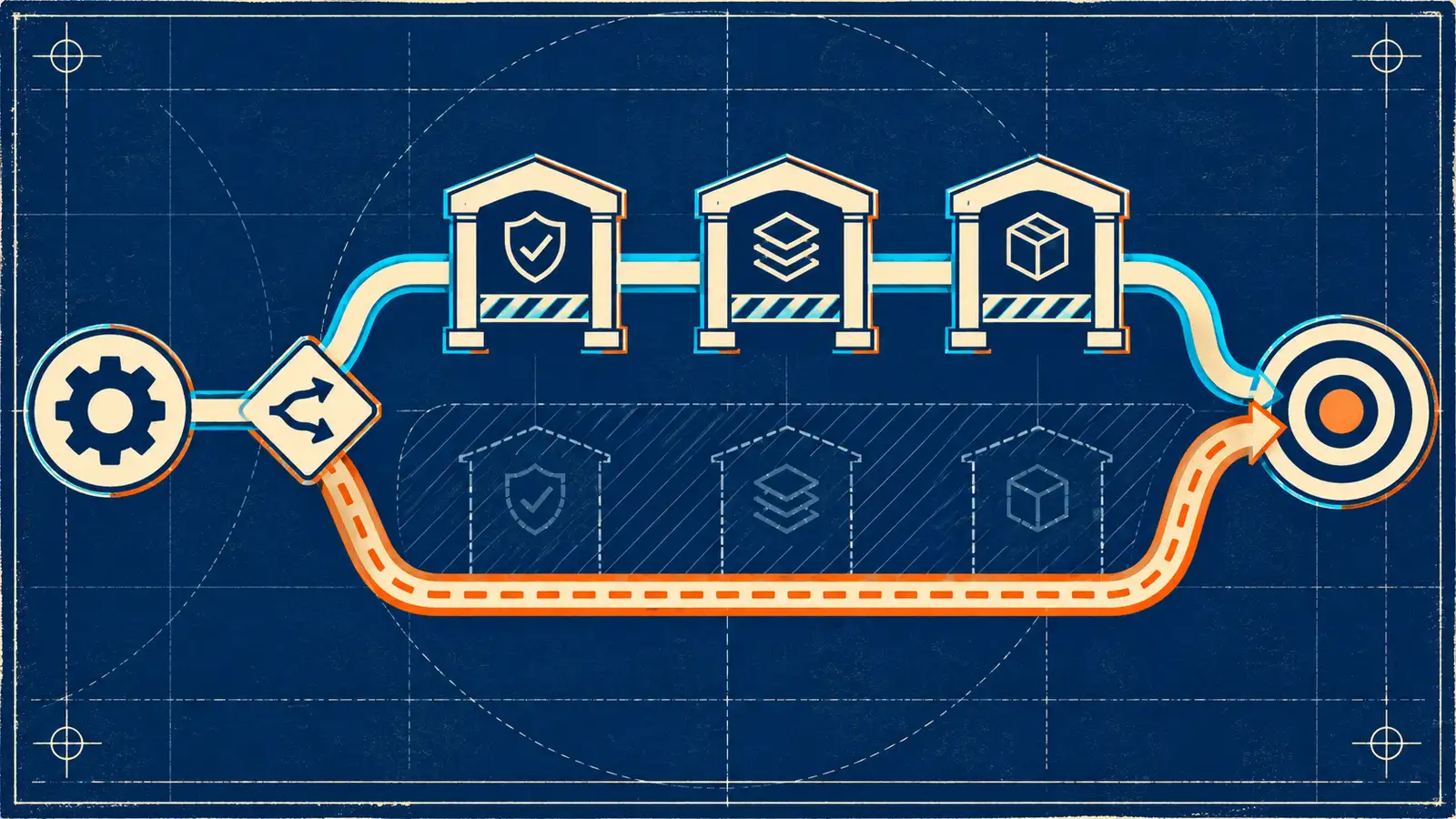
ShadowBench-MCP separates task preservation, operational pressure and route-geometric drift in MCP-style tool routing. Its focused ablation includes 120 routing decisions, producing 96 original-versus-variant comparisons across six security-sensitive workflows. The variants are designed to preserve the task while changing operational cues.
Under the paper’s efficiency-first policy, the reported shadow-invocation rate is 29.2% and the skip rate 26.7%. Under its policy-aware configuration, those rates fall to 4.2% and 1.7%, an 85.7% relative reduction in shadow invocation. The metric suite reports ROC AUC up to 0.94. These figures come from one Groq-hosted qwen3-32b router, six workflows and the authors’ scoring choices. They do not establish prevalence across models or prove that the policy eliminates unsafe execution.
Put invariance before execution
SPILLWAY provides independent related evidence for a deterministic target-admission floor. It extracts allowed identity targets from typed, read-only fields and user-named referents before a model judges ambiguous cases. Across tested settings, its rules blocked standard templated prompt-injection redirects. SPILLWAY studies a different defence and threat model; it does not reproduce ShadowBench and retains limits when an attacker can place a target in an allowed typed field.
For every consequential tool request, generate paired variants that preserve the requested outcome while changing urgency, formatting, irrelevant context and convenience cues. Before execution, compare selected tool, target, permission, data source, staging path and approval requirement. A semantic match is insufficient if the route changes a protected boundary.
Add deterministic gates for identity targets, destructive actions, privilege elevation and external writes. Store the original request, variant, route decision, policy version and reason for any difference. Test skips as well as invocations: silently omitting a validation or staging step can be as material as selecting the wrong tool.
This sharpens the representation-sensitivity benchmark control: the paired representation test now has an explicit route and target outcome.
Decision rule
Do not approve a router because it recognises harmful intent in one phrasing. Approve a workflow only when task-preserving variants retain the same protected route, every target passes deterministic admission and any route difference is blocked or escalated before execution.