Taiwan's packaging park makes validation capacity and training part of the AI supply chain
Baipu Industrial Park pairs advanced-packaging facilities with a validation lab and specialist training centre. The useful capability metric is validated transfer into production, not floor area or training seats.
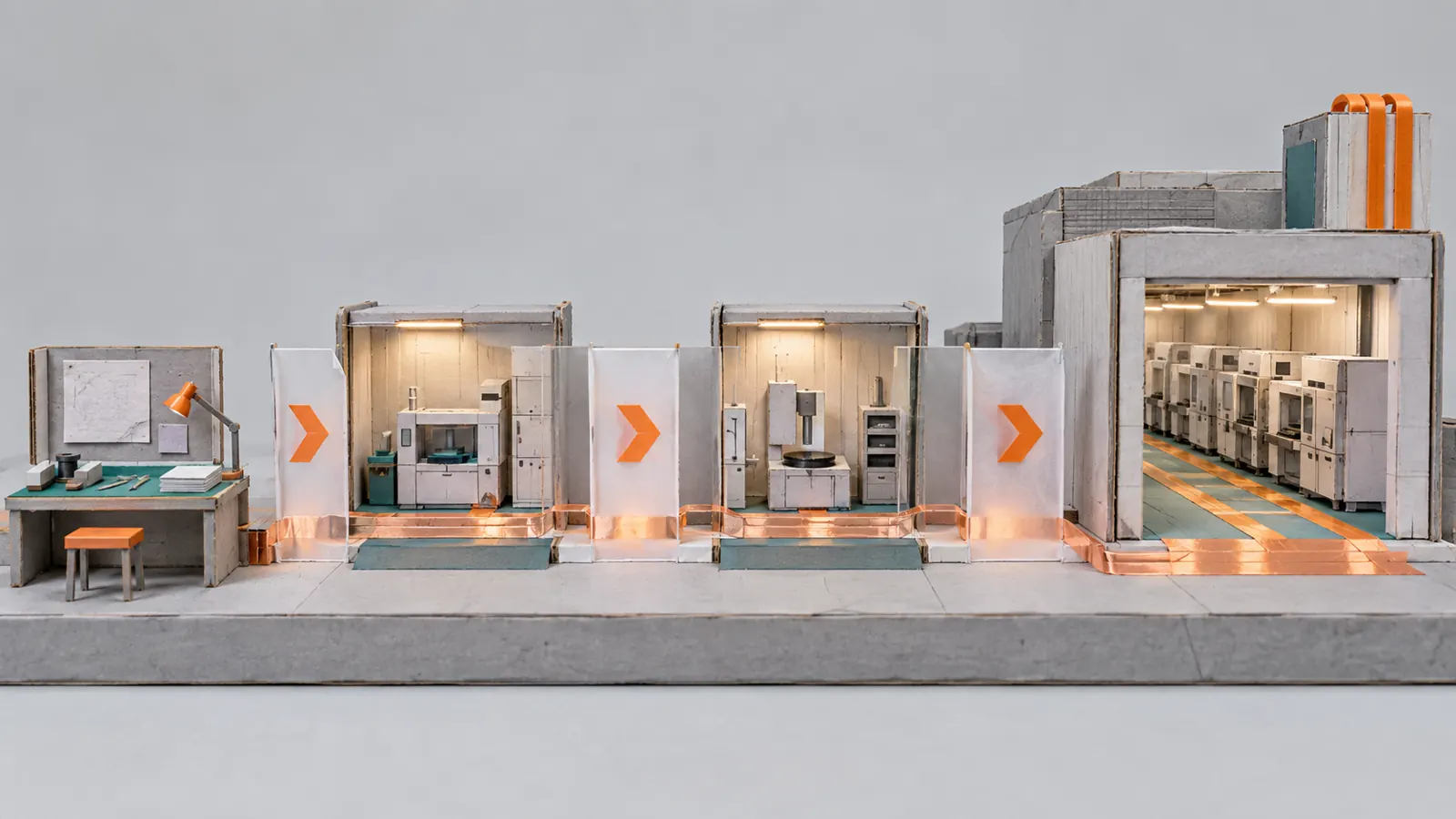
What happened
Taiwan broke ground on Baipu Industrial Park, where TSMC plans validation and specialist-training facilities.
Why it matters
AI infrastructure capacity depends on equipment, materials and people passing shared validation gates before mass production.
Taiwan broke ground on Baipu Industrial Park in Kaohsiung on September 21. Reuters reports that TSMC plans two buildings containing a technology-validation laboratory and a talent-training centre, expected to start operating in the fourth quarter of 2029. The 88.7-hectare park allocates about 53.6 hectares to industrial use.
An earlier Ministry of Economic Affairs announcement framed Baipu as a base for advanced-packaging equipment and materials suppliers. The stated aim is to let suppliers research, test and validate technology near manufacturing, shortening the route into mass production.
The project is relevant to AI because advanced packaging connects multiple components into high-performance systems. But the capability signal is not “a new AI park”. It is the decision to place validation infrastructure and specialist learning next to suppliers and production.
Define the unit of capacity
Land, buildings, equipment purchases and training seats are inputs. A stronger operating measure is validated transfer: how many supplier processes or materials pass an agreed test, how long qualification takes, how often a process fails after transfer, and how quickly people can execute the procedure independently under production controls.
Build a shared capability map for equipment operation, metrology, materials behaviour, contamination control, failure analysis, process integration and safety. For each capability, name the task, evidence standard, authorised assessor and production decision it unlocks. Training should use the same artefacts and acceptance criteria as the validation lab, not a parallel curriculum detached from the line.
Watch the dependencies
Reuters reports that officials also discussed electricity stability through 2035. Water, power, cleanroom capacity, supplier participation and instructor availability are real dependencies. A construction milestone does not prove they will arrive together, and a planned 2029 opening is not current output.
The countercase is that co-location can become expensive redundancy if suppliers already have adequate validation channels or if intellectual-property rules prevent shared learning. Track external supplier use, repeat projects, qualification time and the share of trained specialists retained in relevant roles. Compare those outcomes with remote or existing facilities rather than assuming proximity causes faster transfer.
Govern the handoff
Create one release record for every technology transfer: version, test conditions, deviations, responsible engineers, trained operators, unresolved risks and the production authority that accepted it. When a test changes, link the retraining requirement to the same record.
That record should support three linked queues. The engineering queue handles failed tests and process changes. The learning queue assigns practice, observation and reassessment to people affected by the change. The production queue decides when a qualified version and authorised team may move to volume operation. Shared identifiers allow an auditor to reconstruct why a release proceeded without turning the training system into a copy of the manufacturing system.
Do not count attendance as authorisation. A technician may complete a module yet still need supervised demonstrations on the exact equipment, material and control plan. Conversely, an experienced supplier engineer may prove competence through an assessment without repeating introductory content. The rule should be evidence equivalence: different learning routes can lead to the same documented task standard.
The park also creates a cross-company governance question. Suppliers and TSMC may need to share enough failure evidence to improve qualification while protecting intellectual property. Define the minimum fields that can cross organisational boundaries, retention periods, access roles and escalation for disputed results. Aggregate metrics should not expose a supplier's confidential process, but secrecy cannot make a production acceptance unauditable.
Before opening, establish baselines at existing facilities: qualification time, repeat failure, instructor capacity, operator readiness and supplier travel or queue delay. Without a baseline, the 2029 site may report activity while leaving the claimed transfer advantage untested.
Baipu's design points toward a useful skills principle: frontier capacity is built where technical evidence and role authorisation meet. The park should be judged by reproducible qualifications and safe production handoffs—not by hectares, announcements or course attendance alone.