Document agents need a scan-quality refusal gate
TreasuryQA Bench makes agents search 1,435 scanned financial publications before returning one exact figure. The common failure is a plausible wrong number, so access to an archive is not enough: production needs image-quality and reconciliation controls.
What happened
TreasuryQA Bench tested ten model–harness pairs on 70 exact-figure questions over 1,435 scanned US Treasury publications reached through live document tools.
Why it matters
Most failed attempts returned a wrong number rather than refusing, making silent digit errors a workflow and accountability problem rather than only an OCR accuracy issue.
Retrieval and reading fail together
TreasuryQA Bench recreates a production-shaped archive task. An agent must find the right item among 1,435 image-only US Treasury publications through a Dropbox tool, read scanned pages through hosted OCR or its own tools, and return one exact figure. The benchmark contains 70 questions, a programmatic range grader and three attempts per question for ten model–harness pairs.
The best reported pair solved 64.8% of attempts and the worst 16.7%. Those rankings are bounded to the tested models, harnesses, tools and corpus. More important for workflow design, every agent solved fewer tasks on the blurriest scans. Most failures still returned a number, and the paper identifies digit misreading as the most common cause.
This is a preprint, not a production audit. The archive is a high-fidelity twin, web search is disabled and the exact-figure grading rule does not cover narrative financial analysis. The authors include vendors associated with the document and OCR stack, so the result should not be treated as an independent product comparison.
Image quality is its own control layer
An independent DocIQ study created 5,000 enhanced document images from 500 real-world captures containing blur, shadow, occlusion, creases and moiré. Fifteen people rated each image on overall quality, sharpness and colour fidelity. The proposed document-specific quality model outperformed general image-quality methods on its dataset and an OCR-based benchmark.
DocIQ does not test agents, financial figures or the Treasury corpus. It supports a narrower point: document quality can be measured as a first-class input instead of waiting for downstream extraction to fail.
Put refusal before reconciliation
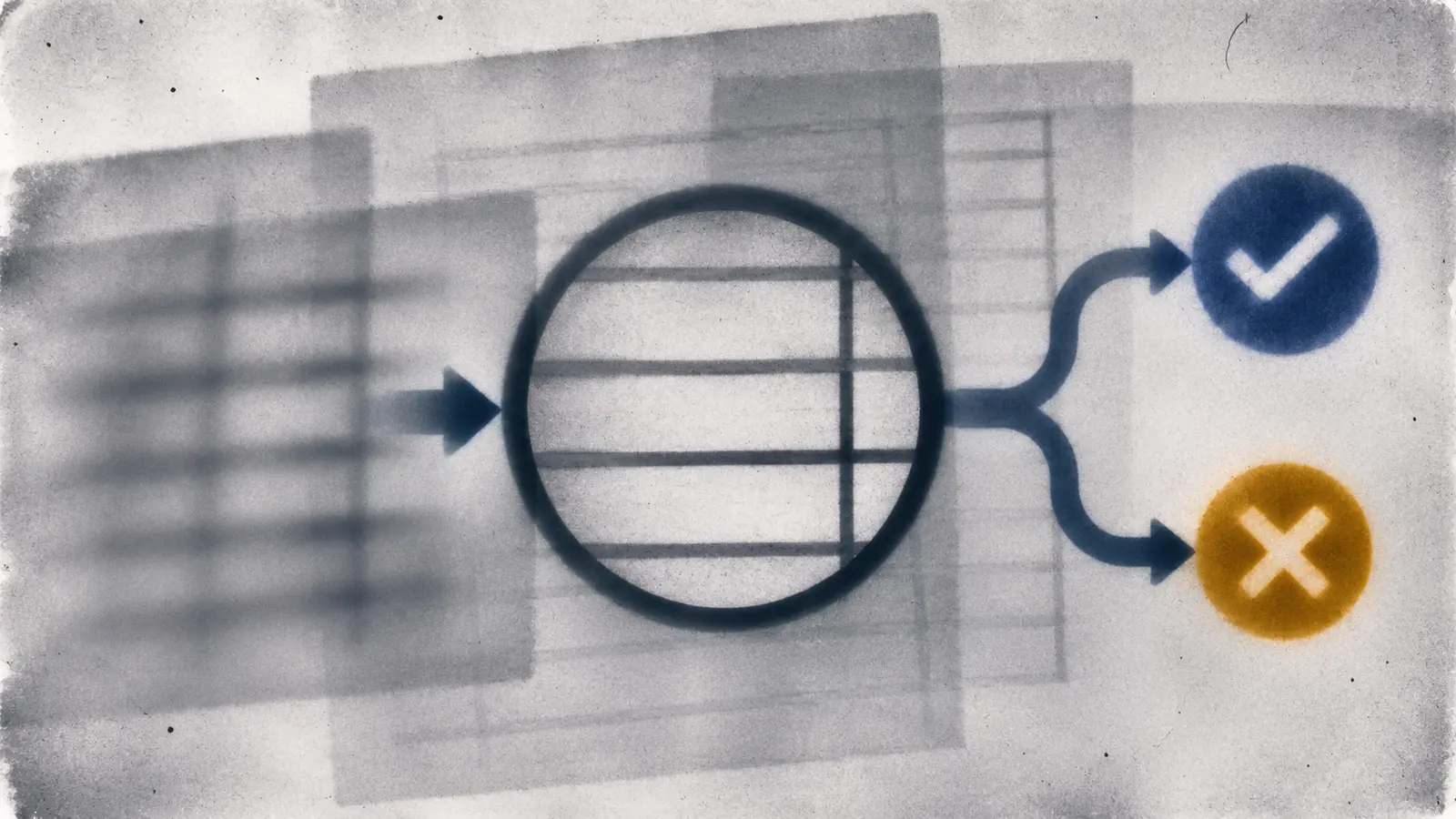
A production path should record page-level quality signals before OCR. Below a locally calibrated threshold, route the page for rescanning or human reading. Above it, require the agent to retain the page reference and crop, extract the surrounding row and column, and run an arithmetic or cross-table check where one exists. For consequential figures, use independent double extraction or human confirmation.
Treat disagreement and low quality as reasons to abstain, not prompts for another fluent guess. Log the original scan, transformation, OCR output, model–harness version, source locator, extracted value, reconciliation result and final approver. This turns a wrong digit from an invisible answer into a traceable exception.
The control complements the task-specific authority ladder for enterprise agents: exact-figure extraction should not inherit authority from generic document retrieval.
Decision rule
Do not let an archive agent return a consequential figure unless the scan passes a quality gate and the value passes an independent reconciliation rule. If either check is unavailable, require refusal or human review.